
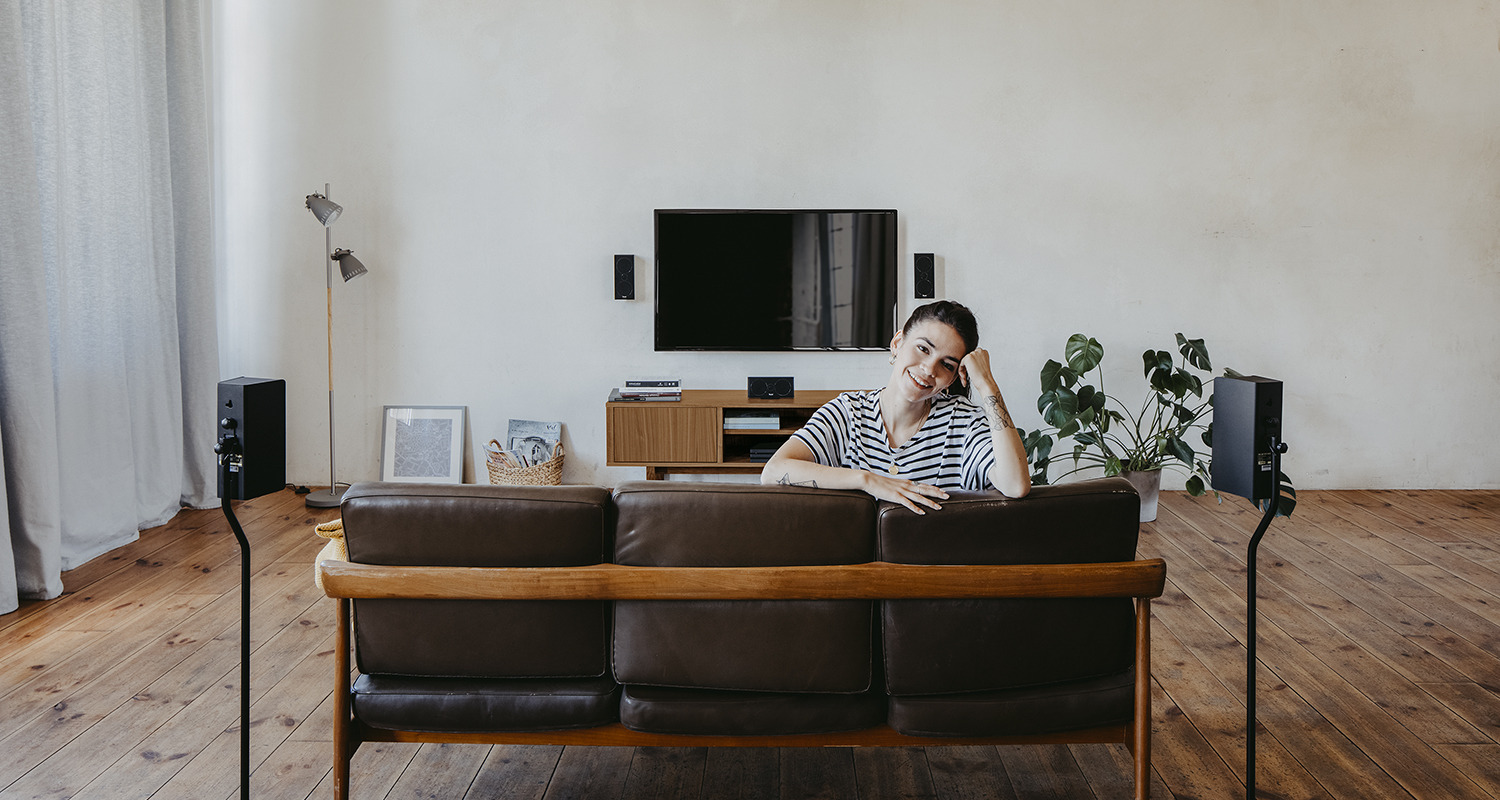

In our guide to speaker placement, we explain the basic rules for stereo and home cinema systems. We cover ideal distances and heights. We also provide tips on different speaker types such as center speakers, dipoles, and direct-radiating speakers. So let’s get started right away!
Try to follow the recommendations for speaker placement as closely as possible. AV receivers offer a wide range of options to electronically compensate for any compromises in placement. As a general rule, you can always experiment based on our recommendations to find what works best acoustically in your room. Let your ears decide!
In another blog post, you’ll find information on room acoustics – which have a major influence on the sound of a home cinema system.
Tips & tricks in the video tutorial on YouTube
In this video tutorial on speaker placement, Lisa explains the basic rules. She covers positioning and explains the stereo triangle. You’ll also get tips on the optimal listening area.
Speaker placement for stereo systems
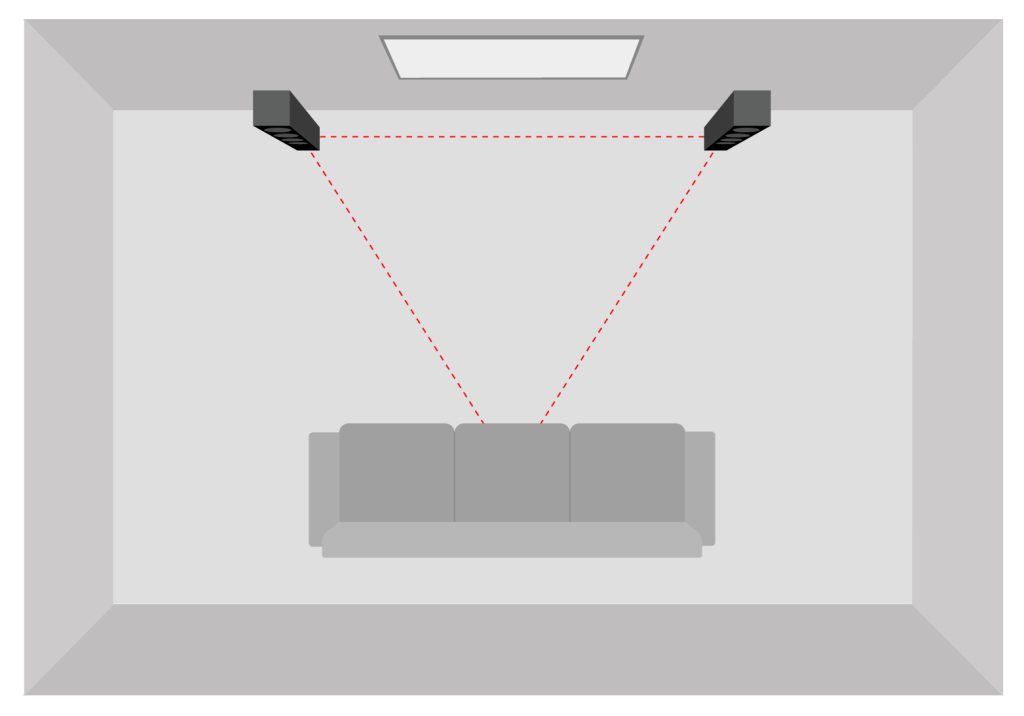
The rules for stereo speakers can essentially be applied to all multi-channel configurations with front speakers. The two speakers and the listening area should ideally form what is known as the stereo triangle. In this setup, the distance between the two speakers is the same as the distance between the listener and each speaker (which would form an equilateral triangle if you imagined connecting the points).
The front speakers are angled toward the listening area at a 60-degree angle. Using the conversion factor 0.87, you can calculate the ideal distance between the seating position and the midpoint between the speakers – where the TV should be placed. The tip of the stereo triangle is often referred to as the “sweet spot”.
Example calculation: 4 m (distance between speakers) × 0.87 = 3.48 m
Reading tip: Stereophony – two is better than one
Expanding stereo speakers with a subwoofer: 2.1 set
The rules for subwoofer placement apply regardless of the specific speaker configuration in which it is used. In general, the position of the subwoofer in the room is not particularly critical, as our hearing can only locate bass (low frequencies) very roughly or not at all. Nevertheless, mistakes can still be made when placing a subwoofer. The key point is to ensure that bass frequencies can propagate properly throughout the room.
On the one hand, the subwoofer should be able to radiate sound waves freely into the room and not be blocked by cabinets or other pieces of furniture. On the other hand, room resonances and cancellations must be avoided. The risk of these unwanted effects – also known as room modes – is particularly high when the subwoofer is placed in a corner. Placement close to a wall can also have negative effects. This is why the often recommended position “centered or slightly offset between the front speakers” is usually a good choice.
Speaker placement for 5.1 systems
The speaker placement of a classic home cinema system consists of a total of six speakers. Two front speakers and the center speaker primarily reproduce dialogue, film music, and the most important sound effects. The subwoofer delivers the bass, and the two effect speakers create the surround sound.
Reading tip: 5.1 or 7.1? Which sound system is right for me?
Optimal height for 5.1 home cinema sets with dipoles in the rear area
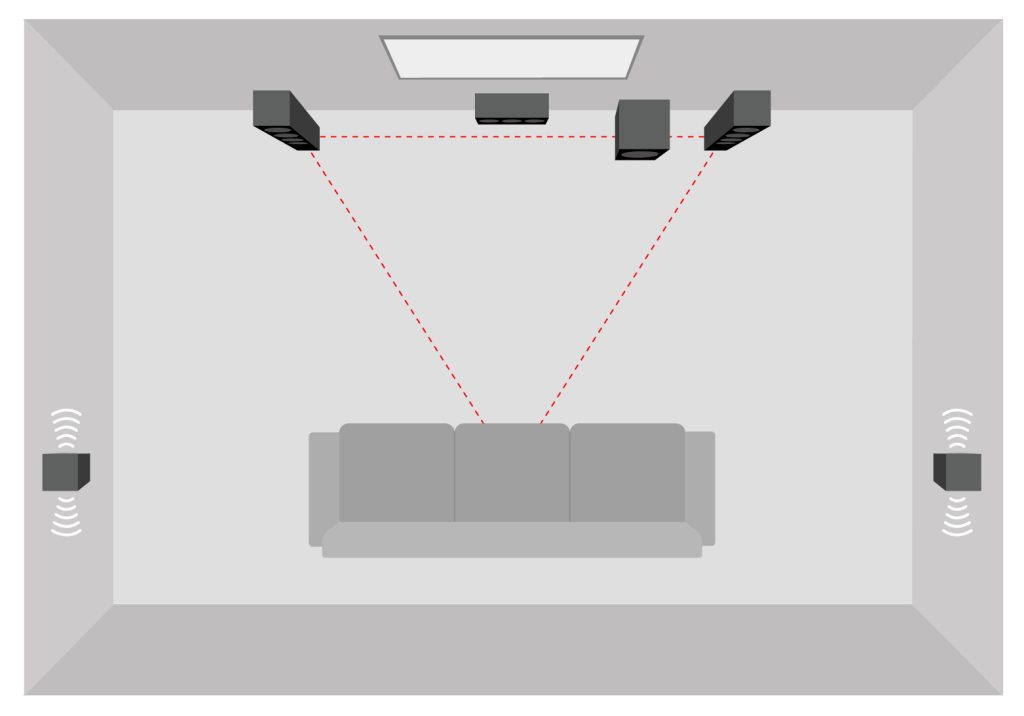
In a 5.1 setup, the front speakers are placed next to the TV at equal distances on the left and right, following the stereo tradition (as mentioned above: distance to the listener = distance between left and right speaker), or mounted on the wall. Using floor stands automatically ensures an optimal height for the front speakers.
Recommended height for dipoles
For wall-mounted or shelf speakers, the following applies: the installation height should be between 40 centimeters and 1.20 meters. If the height is outside this range, you can slightly tilt the front speakers up or down toward the listening position. It is important that the center and front speakers are roughly aligned on a straight line, possibly also on a slightly curved arc toward the TV/screen. A misaligned speaker front can cause differences in (sound wave) travel times, which in turn could impair the symmetry of the sound image.
Since the center speaker reproduces the actors’ dialogue, it must be positioned as centrally as possible below or above the screen or projection surface. Only then do image and sound form a cohesive unit. If the center is mounted outside a height between 40 centimeters and 1.20 meters, it should be slightly tilted up or down toward the listener.
The dipole speakers should ideally be mounted to the sides of the listening position at a height of 1.40 to 2.10 meters. Many Teufel dipoles already feature an integrated wall mount. They radiate sound forward (toward the TV/screen) and backward (toward the rear wall), so that no direct sound is heard at the listening position. The distance to the rear wall should be at least 10 centimeters.
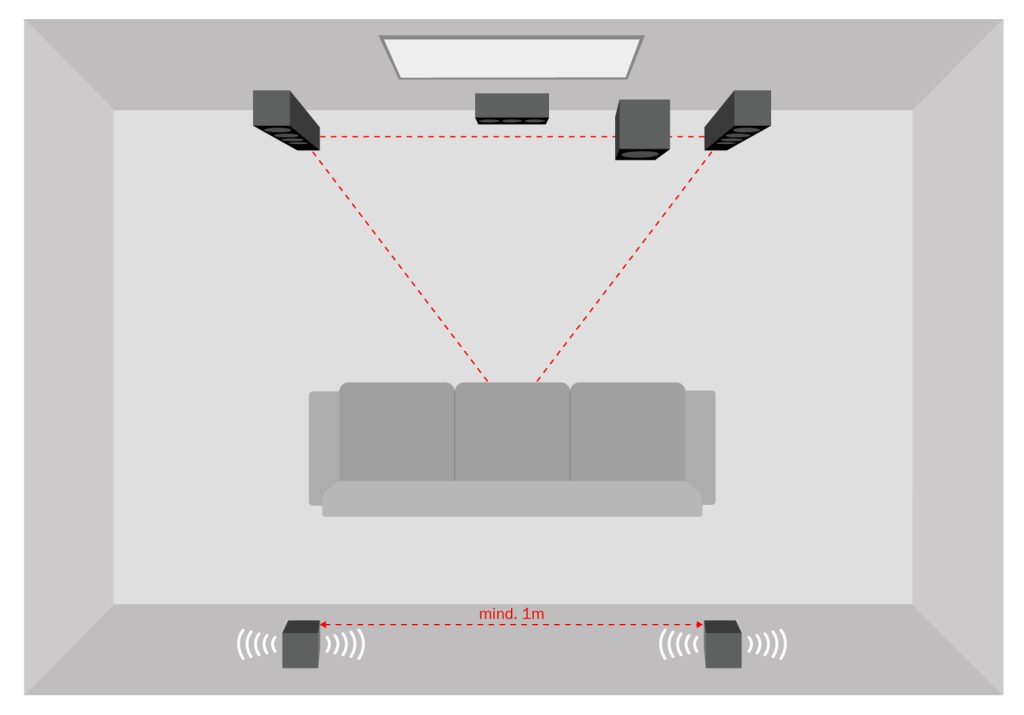
You can also mount the dipoles behind the seating position on the rear wall at a height of 1.40 to 2.10 meters using a wall mount. Almost all Teufel dipoles have an integrated M6 threaded insert on the base for attaching the wall mount.
Recommended distance for dipoles
For wall mounting, we recommend optionally available wall brackets. This allows the dipole speakers to be rotated at a 45-degree angle, with one sound-radiating side facing the rear wall and the other facing the side wall. The sound reflections created in this way produce the desired diffuse sound impression for the sound effects. The distance to the side wall of the room should be at least 10 centimeters.
As mentioned, the position of the subwoofer (with a recommended crossover frequency of below or exactly 120 Hz) is largely flexible and does not affect the other speakers. Ideally, it should be placed on the line between the two front satellites.
5.1 home cinema sets with direct-radiating speakers in the rear area
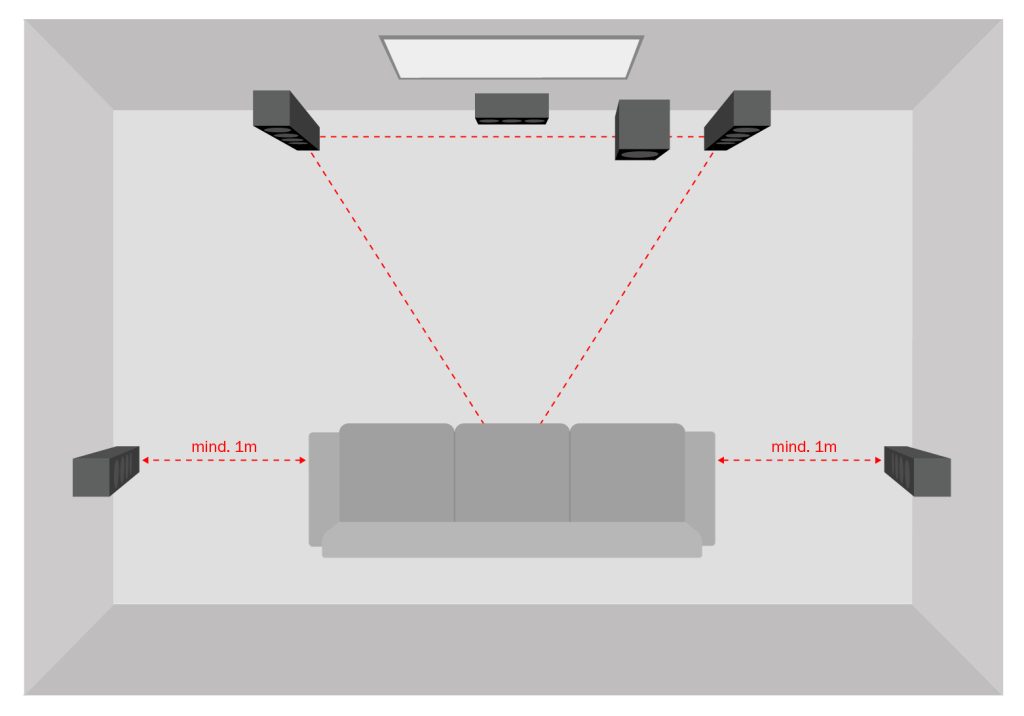
In a 5.1 setup, the front speakers are placed next to the TV at equal distances on the left and right, following the stereo tradition (as mentioned above: distance to the listener = distance between left and right speaker), or mounted on the wall. Using floor stands automatically ensures an optimal height for the front speakers.
Recommended height for direct-radiating speakers
For wall-mounted or shelf speakers, the following applies: the installation height should be between 40 centimeters and 1.20 meters. If the height is outside this range, you can slightly tilt the front speakers up or down toward the listening position. It is important that the center and front speakers are roughly aligned on a straight line, possibly also on a slightly curved arc toward the TV. A misaligned speaker front can cause differences in (sound wave) travel times, which could impair the symmetry of the sound image.
Since the center speaker reproduces the actors’ dialogue, it must be positioned as centrally as possible below or above the screen or projection surface. Only then do image and sound form a cohesive unit. If the center is mounted outside a height between 40 centimeters and 1.20 meters, it should be slightly tilted up or down toward the listener.
Recommended distance for direct-radiating speakers
In a Concert Set with direct-radiating speakers (which radiate sound directly toward the listening area), the rear speakers should be placed to the left and right of the seating position. The distance of the rear speakers to the listening position should be at least one meter.
If you cannot maintain the minimum distance, make sure the speakers are not aimed directly at the seating area. You can direct the speakers over listeners’ heads toward the opposite wall or toward the TV. If the distance to the listening position is more than one meter, the rear speakers should ideally be aligned with the front speakers – preferably on floor stands or mounted on the wall at a height of up to 2.10 meters.
If the speakers need to be mounted much higher or lower, aiming them toward the listening position can be helpful. For wall mounting, use suitable wall mountsOpens in new tab from our accessories shop.
As mentioned, the position of the subwoofer (with a recommended crossover frequency of below or equal to 120 Hz) is largely flexible and does not affect the other speakers. Ideally, it should be placed on the line between the two front satellites.
Our sound tip: Wireless surround sound with Teufel Effekt direct-radiating speakers
Speaker placement for 7.1 systems
A 7.1 system further expands the surround sound. The listener should be enveloped by sound from all four sides. To achieve this, a 7.1 setup includes two additional satellites behind the listening area – the rear center speakers.
7.1 home cinema sets with dipoles in the rear area
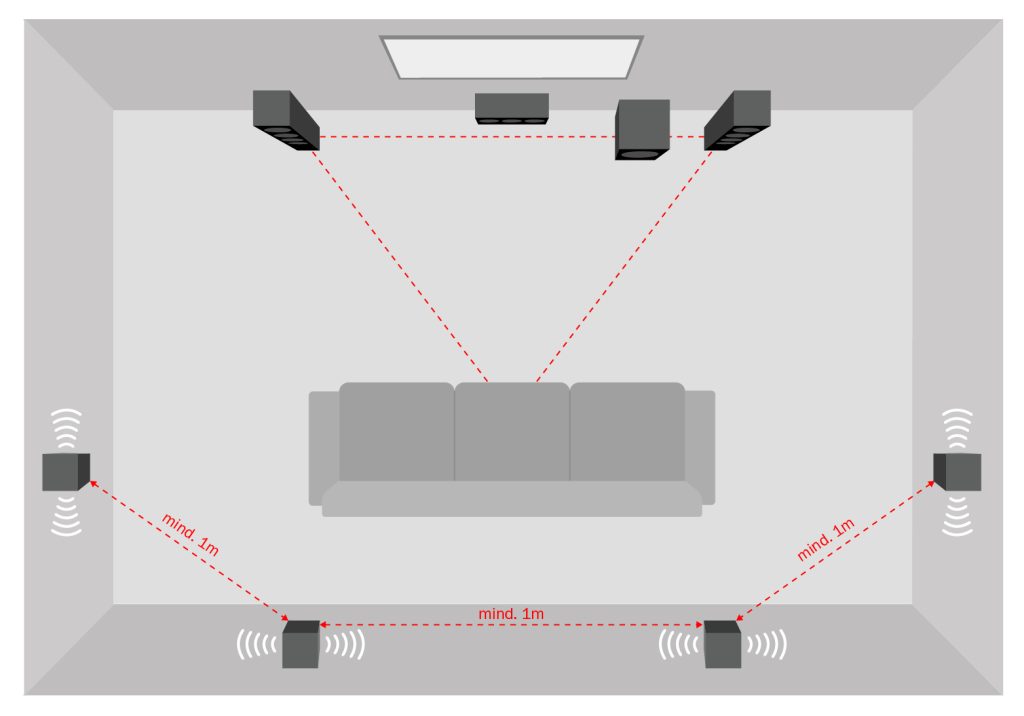
In a 7.1 setup, the front speakers are placed next to the TV at equal distances on the left and right, following the stereo tradition (as mentioned above: distance to the listener = distance between left and right speaker), or mounted on the wall. Using floor stands automatically ensures an optimal height for the front speakers.
For wall-mounted or shelf speakers, the following applies: the installation height should be between 40 centimeters and 1.20 meters. If the height is outside this range, you can slightly tilt the front speakers up or down toward the listening position. It is important that the center and front speakers are roughly aligned on a straight line, possibly also on a slightly curved arc toward the TV/screen. A misaligned speaker front can cause differences in (sound wave) travel times, which could impair the symmetry of the sound image.
Since the center speaker reproduces the actors’ dialogue, it must be positioned as centrally as possible below or above the screen or projection surface. Only then do image and sound form a cohesive unit. If the center is mounted outside a height between 40 centimeters and 1.20 meters, it should be slightly tilted up or down toward the listener.
The dipoles should ideally be mounted to the sides of the listening position at a height of 1.40 to 2.10 meters. Many Teufel dipoles already feature an integrated wall mount. They radiate sound forward (toward the TV/screen) and backward (toward the rear wall), so that no direct sound is heard at the listening position. The distance to the rear wall should be at least 10 centimeters.
If the distance between the listening position and the rear center speaker pair (7.1) is less than one meter, for example because the sofa is placed against the rear wall, we recommend using dipoles instead of direct-radiating speakers.
In a 7.1 system, the effect speakers are ideally mounted on the side walls next to the listening position, while the rear center speakers are mounted on the rear wall – each at a height of 1.40 to 2.10 meters.
For the distances between the four effect speakers, the following applies: the distance between all speakers should be the same. In addition, there should be at least one meter of distance between the speakers. If the distances differ or the four rear speakers are mounted at different heights, this asymmetry can be compensated for in the speaker management of the AV receiver. To do this, you must enter the actual distances of the individual speakers; the receiver software then automatically compensates for the resulting differences in sound wave travel times.
As mentioned, the position of the subwoofer (with a recommended crossover frequency of below or equal to 120 Hz) is largely flexible and does not affect the other speakers. Ideally, it should be placed on the line between the two front satellites.
7.1 home cinema sets with 2 direct-radiating speakers and 2 dipoles in the rear area
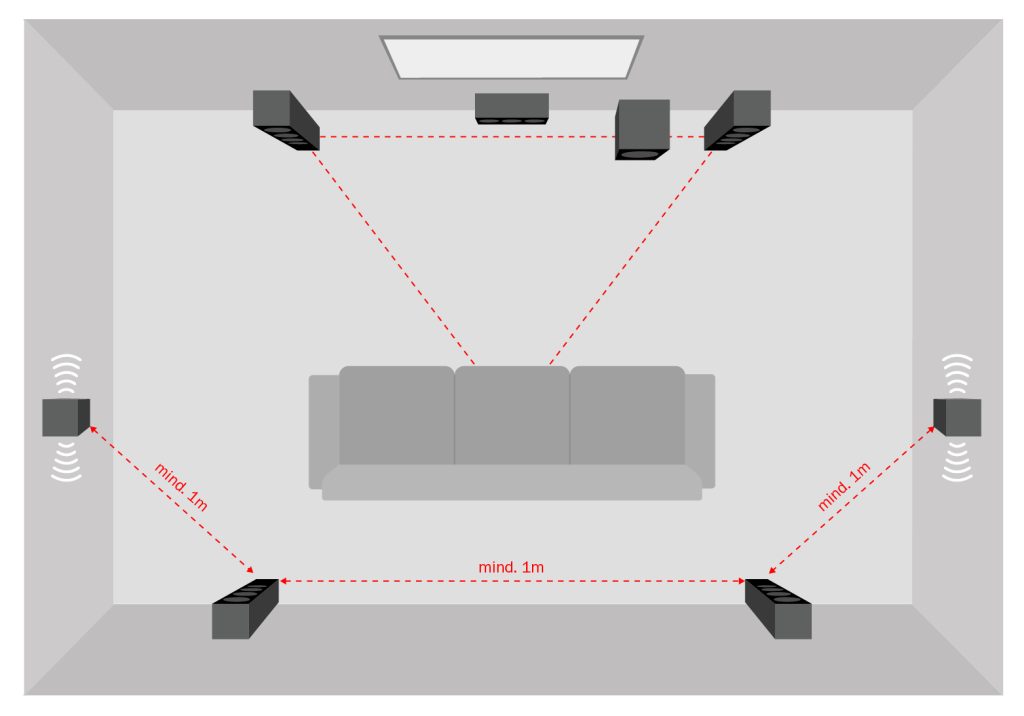
In a 7.1 setup, the front speakers are placed next to the TV at equal distances on the left and right, following the stereo tradition (as mentioned above: distance to the listener = distance between left and right speaker), or mounted on the wall. Using floor stands automatically ensures an optimal height for the front speakers.
For wall-mounted or shelf speakers, the following applies: the installation height should be between 40 centimeters and 1.20 meters. If the height is outside this range, you can slightly tilt the front speakers up or down toward the listening position. It is important that the center and front speakers are roughly aligned on a straight line, possibly also on a slightly curved arc toward the TV/screen. A misaligned front speaker array can cause differences in (sound wave) travel times, which could impair the symmetry of the sound image.
Since the center speaker reproduces the actors’ dialogue, it must be positioned as centrally as possible below or above the screen or projection surface. Only then do image and sound form a cohesive unit. If the center is mounted outside a height between 40 centimeters and 1.20 meters, it should be slightly tilted up or down toward the listener.
The dipoles should ideally be mounted to the sides of the listening position at a height of 1.40 to 2.10 meters. Many Teufel dipoles already feature an integrated wall mount. They radiate sound forward (toward the TV/screen) and backward (toward the rear wall), so that no direct sound is heard at the listening position. The distance to the rear wall should be at least 10 centimeters.
If the distance between the listening position and the rear center speaker pair (7.1) is less than one meter, for example because the sofa is placed against the rear wall, we recommend using dipoles instead of direct-radiating speakers.
In a 7.1 system, the effect speakers are ideally mounted on the side walls next to the listening position, while the rear center speakers are mounted on the rear wall – each at a height of 1.40 to 2.10 meters.
For the distances between the four effect speakers, the following applies: the distance between all speakers should be the same. In addition, there should be at least one meter of distance between the speakers. If the distances differ or the four rear speakers are mounted at different heights, this asymmetry can be compensated for in the speaker management of the AV receiver. To do this, you must enter the actual distances of the individual speakers; the receiver software then automatically compensates for the resulting differences in sound wave travel times.
As mentioned, the position of the subwoofer (with a recommended crossover frequency of below or equal to 120 Hz) is largely flexible and does not affect the other speakers. Ideally, it should be placed on the line between the two front satellites.
7.1 home cinema sets with four direct-radiating speakers in the rear area
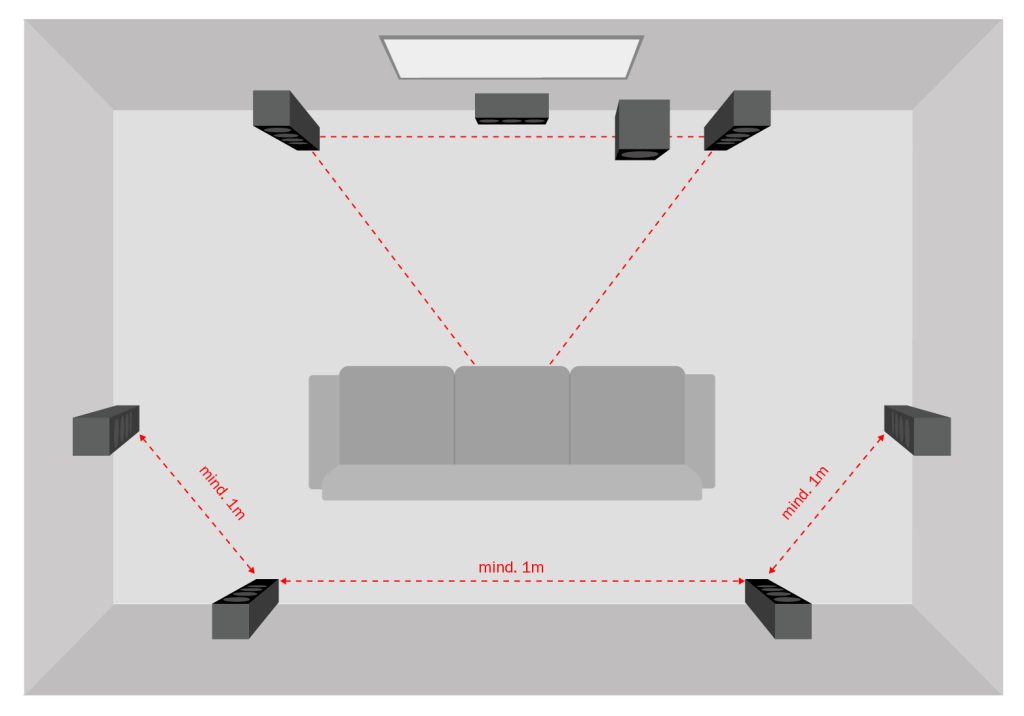
Speaker placement with four direct-radiating speakers in the rear area is also possible. However, all effect speakers should then be positioned more than one meter away from the listening position. If you cannot maintain the minimum distance, do not aim the speakers directly at the listening position. The rear speakers should always be mounted at a height between 1.40 and 2.10 meters.
Option: Front height speakers / front high speakers
Front height speakers (often referred to simply as front high) add more spaciousness and brilliance to movie soundtracks. The AV receiver must be equipped with front high or “presence” speaker connections for this purpose. The front height speakers should be positioned directly above the screen or TV and slightly angled toward the listening position. Front high speakers can be installed in addition to a 5.1 set or a 7.1 set.
Speaker placement for a Dolby Atmos setup
In the following video tutorial, we explain which Dolby Atmos speaker types are available and what the differences are. We also provide basic information on setting up a Dolby Atmos home cinema.
Dolby Atmos, unlike other surround sound standards, is not channel-based but works with so-called sound objects. With the previously described 5.1 or 7.1 systems, the audio is mixed in advance so that it later works with exactly those six or eight channels. Dolby Atmos, on the other hand, can address channels flexibly.
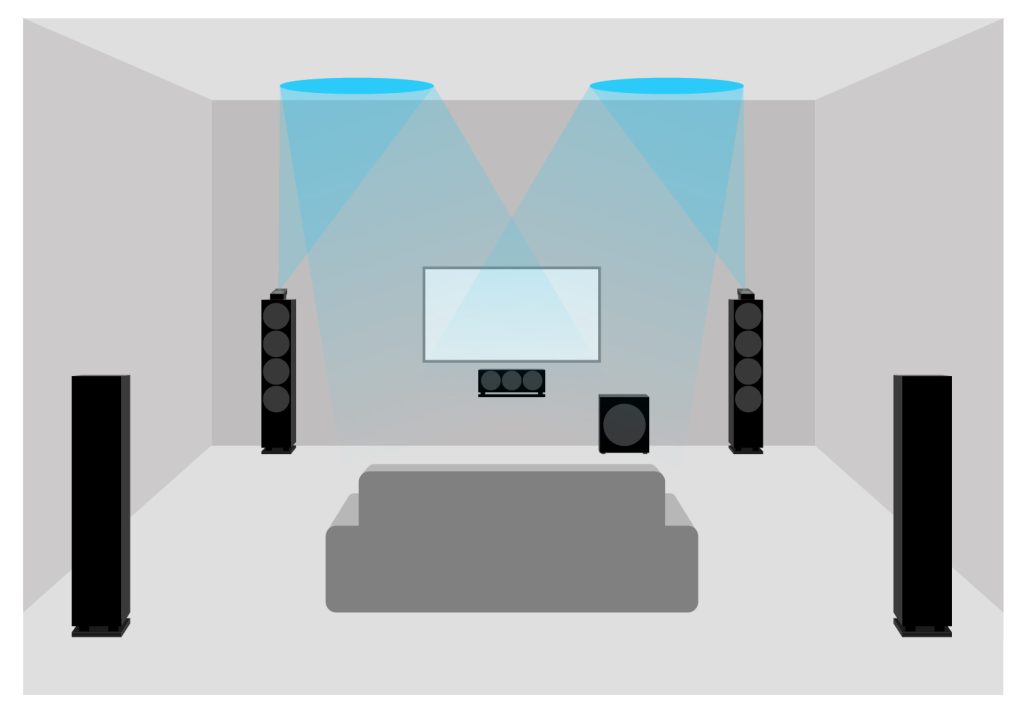
The minimum number of speakers for Atmos sound is eight (5.1.2). In theory, up to 32 speakers (as 31.1 or 24.2.6) can be operated. When sound engineers produce in Dolby Atmos, they can position sound objects spatially without having to assign them to a specific channel. An explosion on the left side of the screen is simply defined as a sound coming from a specific position on the left, at the appropriate level and at the appropriate time. A similar method has been used in gaming engines for years.
The placement of the Dolby Atmos add-on speakers (Reflekt 2) is relatively straightforward, as they are placed on top of the front speakers. For Atmos sound, at least two – preferably four – add-on speakers are required.
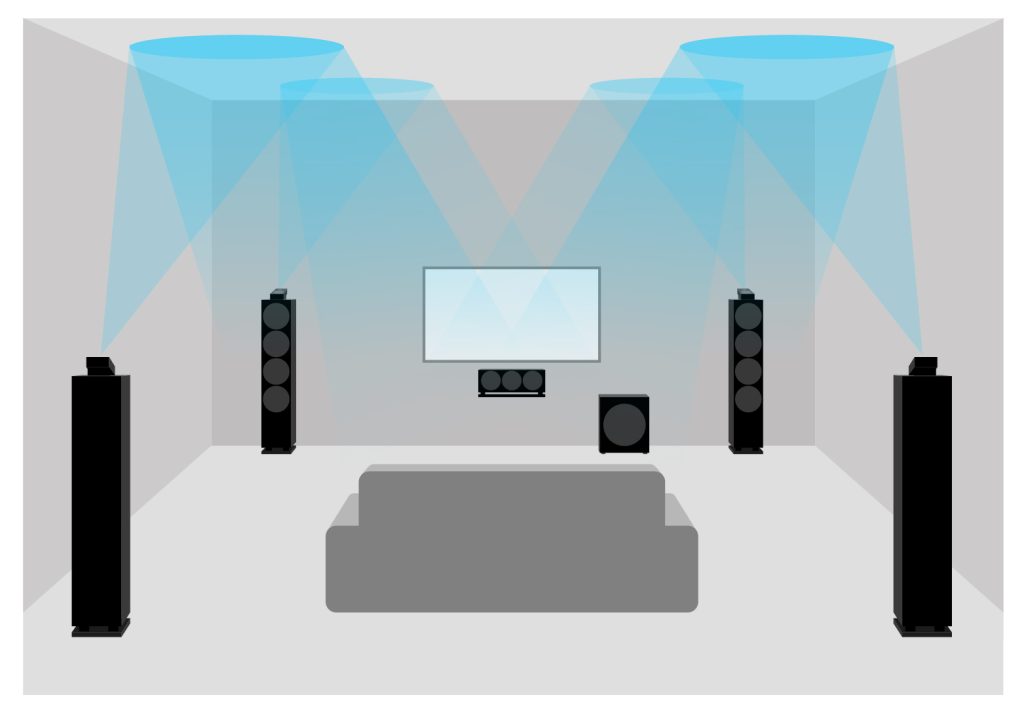
The immersive sound is created through precisely used sound reflections.
Can it be done without cables? Yes, almost!
Are you tired of laying cables and would prefer to set up and connect your speakers wirelessly? Depending on how many speakers are involved, this is indeed possible (except for the always necessary power cables). In theory, you can connect all speakers in your home via Wi-Fi – keyword “multiroom”. However, a home cinema operated entirely via Wi-Fi is still a thing of the future. That said, a (nearly) wireless home cinema can save you a lot of long cable runs and give you more flexibility in placement.
Here is an overview of the advantages and disadvantages of a (nearly) wireless home cinema:
| Vorteile | Nachteile |
|---|---|
| Einfache Installation | Späteres Austauschen einzelner Komponenten innerhalb einer kabellosen Komplettanlage ist schwieriger |
| Mehr Flexibilität bei der Aufstellung – keine Kompromisse aufgrund der Kabellänge | Meist höherer Preis |
| Weniger Kabelsalat |
The setup of a cable-reduced home cinema is basically divided into two parts. The front speakers, the center speaker, and everything else located directly around your TV are connected as usual: both to power and to an AV receiver. All rear speakers and the subwoofer(s), however, can also receive the sound wirelessly.
A wireless subwoofer – as included in many Teufel systems – only needs to be connected to power. It receives the audio signal for the booming bass via wireless transmission. Rear speakers can be driven either via an integrated amplifier or via a second small amplifier responsible for the entire rear area of your home cinema system. A simple solution is also wireless transmitters and receivers.
After theory comes practice: Teufel speakers for perfect sound placement
 Opens in new tab
▶ REFLEKT 2Opens in new tab: Depending on the room and setup, the REFLEKT 2 can be used as height, rear, or presence speakers and thus optimally adapted to the conditions. The optimized bracket makes wall mounting or placement on existing floorstanding speakersOpens in new tab easier. Thanks to the adapted design and variants such as the white version that matches the ULTIMA series, the REFLEKT 2 also blend unobtrusively into different living spaces. They are compatible with all passive ULTIMA, THEATER, and SYSTEM speakers.
▶ ULTIMA 40 Surround + Denon X2800H DAB “5.1 set”Opens in new tab: Looking for a 3D sound upgrade? Our Ultima 40 deliver Atmos sound when you upgrade them with the Reflekt 2Opens in new tab speakers. The floorstanding speakers deliver powerful yet incredibly detailed surround sound. The height speakers are simply placed on top of the front speakers. The included Denon AV receiver supports Dolby Atmos as well as Bluetooth, Spotify, Deezer, and AirPlay 2.
▶ You can find all home cinemaOpens in new tab and stereo speakersOpens in new tab from Teufel in our shop.
Complete systems for your home cinema
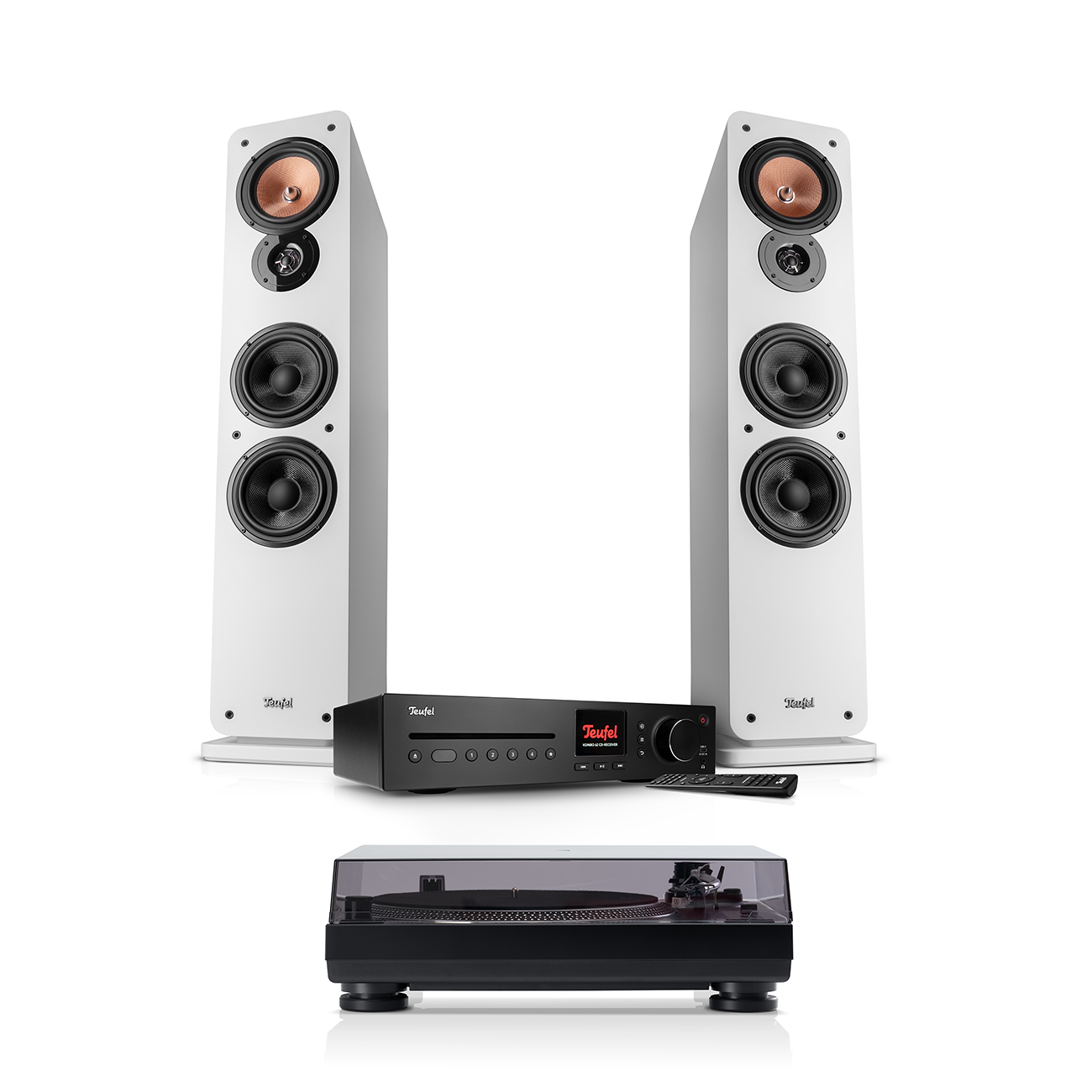
ULTIMA 40 KOMBO 3 + DUAL DT 250
999,99 €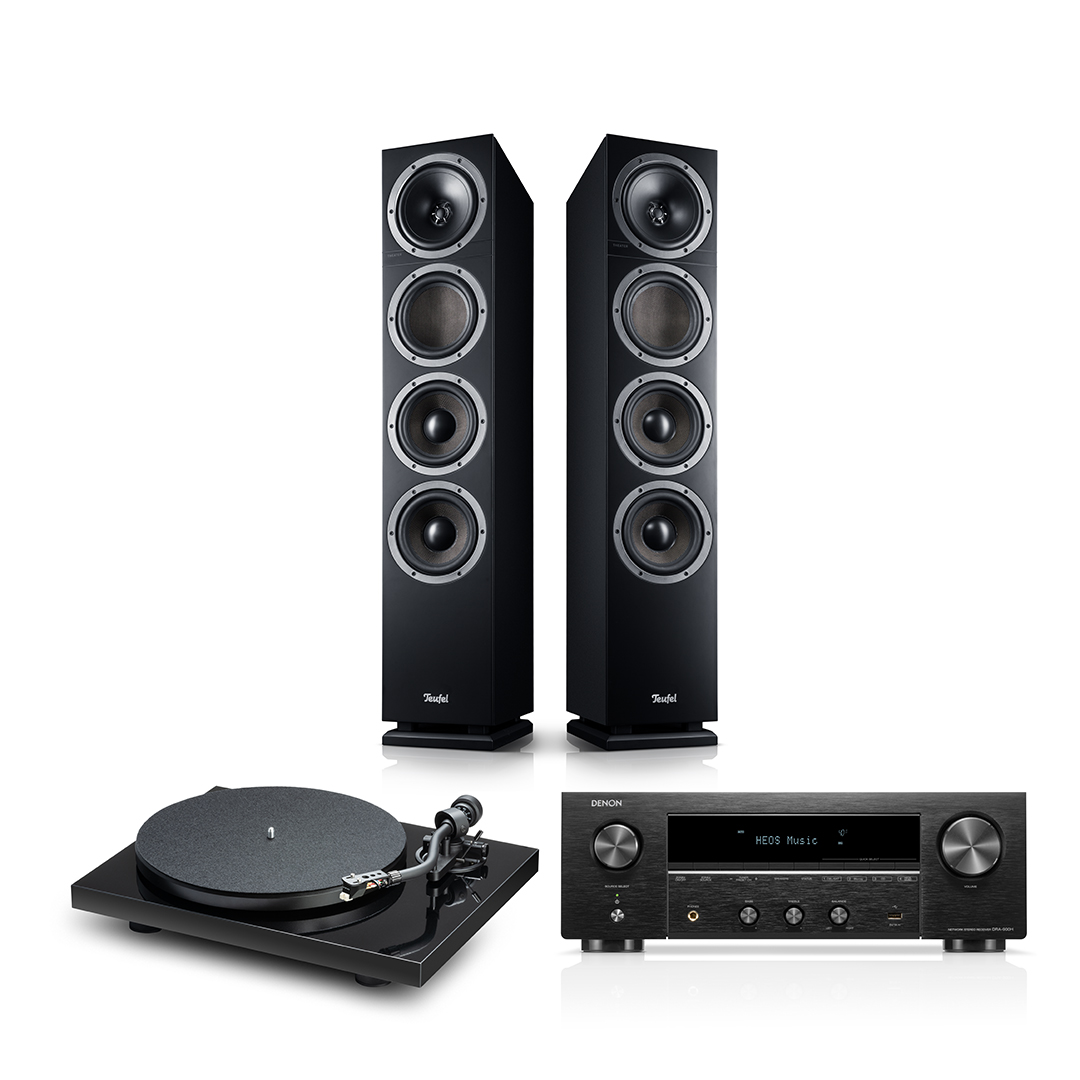
THEATER 500 + DENON DRA-900H + Pro-Ject Debut S Phono
1849,99 €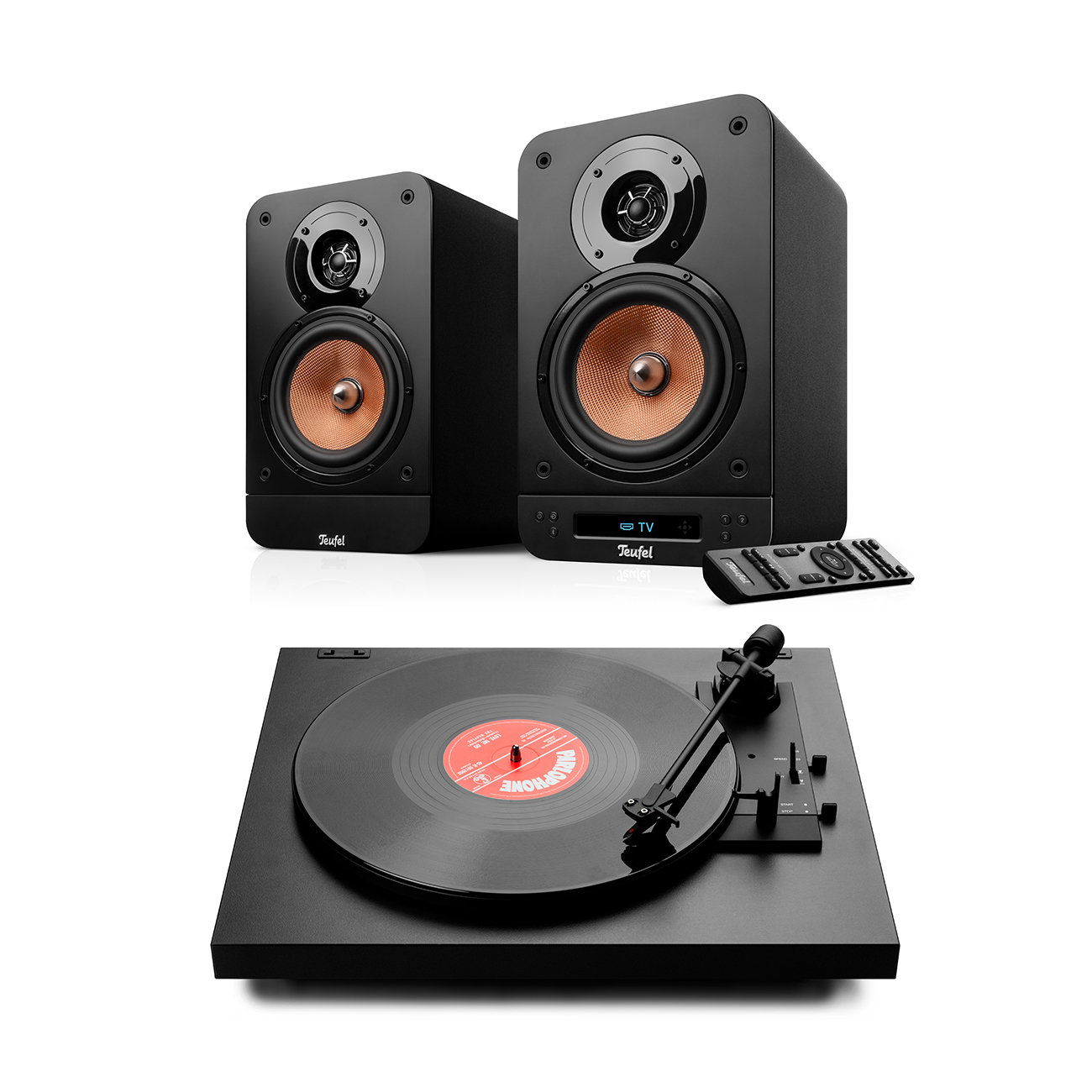
ULTIMA 25 ACTIVE 2 + Pro-Ject A1.2
929,99 €Frequently asked questions about speaker placement
The position of your speakers has a decisive influence on the sound. Even high-quality speakers can sound flat or boomy if they are positioned incorrectly. Correct placement gives you a precise stereo stage, balanced bass, and clear highs – without expensive accessories.
The stereo triangle is the basis for spatial sound: the two speakers and your listening position form an equilateral triangle. This ensures that sound waves reach your ears at the same time, enabling realistic positioning of voices and instruments. The sweet spot is located at the tip of this triangle.
Placing speakers too close to walls often leads to exaggerated bass and muddy sound. A rule of thumb is to keep at least 50–90 cm distance from the rear wall, even more for bass-reflex speakers. Some space should also be left at the sides to avoid reflections.
Slightly angling the speakers toward the listening position improves stereo imaging and creates a clearer soundstage. The tweeters should be at ear level so that voices and details are not distorted.
At a glance: speaker placement
- For stereo systems, the stereo triangle is used, with the listener seated in the middle at the so-called “sweet spot”.
- In 5.1 systems, dipole speakers are added. These are usually positioned to the left and right of the listening position at a height of 1.40 to 2.10 meters.
- The position of the subwoofer can be chosen relatively freely, as the human ear has difficulty localizing bass. Ideally, it is placed between the two front speakers.
- In a 7.1 system, the additional satellite speakers are positioned behind the listening area, also at a height of 1.40 to 2.10 meters.
- For Dolby Atmos (5.1.2 systems), the Reflekt speakers are placed on top of the two front speakers. They radiate toward the ceiling and use it as a reflective surface.
Audioblog
The podcast has been automatically generated by AI, but the content comes directly from an article written by our own editorial team. This ensures the quality remains high and allows you to hear our story in a new format.


Leave a Reply