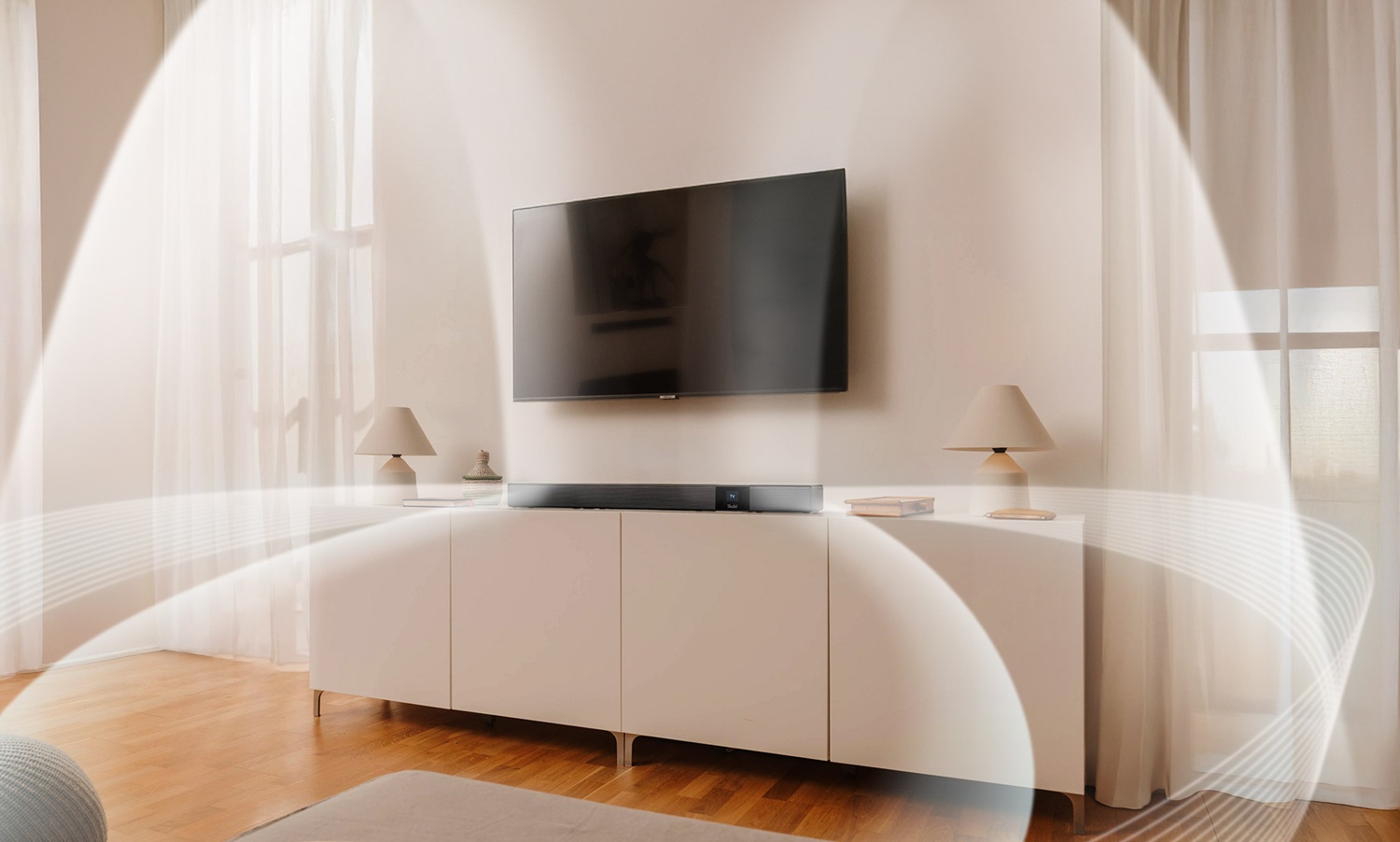

Three host countries, 48 participating nations, 104 matches: the 2026 World Cup in Canada, Mexico and the USA will be the biggest of all time. Here you’ll find the key facts about the final tournament – and learn why, when watching football at home, it’s not just the picture but also the sound that creates a real World Cup atmosphere.
World Cup 2026: bigger tournament, bigger stage
The “FIFA World Cup 26” – the official name – will be the biggest tournament of its kind to date: 48 teams will compete in 104 matches. The World Cup runs from 11 June to 19 July 2026.
The hosting itself is special: for the first time, three countries (the USA, Canada and Mexico) will jointly host a men’s World Cup. Matches will be played in 16 cities, from Vancouver to Los Angeles and Dallas all the way to Mexico City. For European viewers, this means: because of the time difference, many matches will kick off late in the evening or during the night. All the more reason to take a close look at the schedule if you want to watch certain games live.
The teams from Cape Verde, Curaçao, Jordan and Uzbekistan will appear on the biggest football stage for the first time in 2026. Curaçao in particular go into the tournament as clear underdogs – and face Germany straight away in the opening match: on 14 June, the German national team kick off against the World Cup debutants.
The sound of football: what the 2026 World Cup could sound like
The 2026 World Cup will be a major tournament acoustically too: with 48 teams, fan groups from all over the world will be travelling to the venues. In the stadiums, South American chants meet English pop refrains, short shouts meet anthemic national songs, drums meet whistling and spontaneous cheers.
Unlike many regular club matches, games between national teams in particular create this special sound that goes far beyond what’s happening on the pitch. International fan chants carry pride and pain, nervousness and euphoria through the stadiums – and often stay in your memory just as much as a late goal or a missed penalty. There are probably countless songs and chants that have accompanied national teams for years: original anthems and rewritten pop songs, old classics and new fan favourites like the “Oh-oh-oh-oh-oh-oh”, inspired by “Seven Nation Army” by The White Stripes.
This sound is also an integral part of matches played by the DFB team. “Stand up if you’re for Germany” (to the melody of “Go West” by the Pet Shop Boys), “Oh, how beautiful this is”, “Come on Germany, score a goal” or the classic “Germaaaaaany, Germaaaaaany” have been sung enthusiastically (or simply belted out) for decades. And when the game picks up pace, you can hear these songs immediately. The fans don’t just stand – often quite literally – in the stands, but also act as the “12th man” behind the team.
Other countries have great fan chants too
- Argentina recently showed with “Muchachos” how powerfully a song can shape an entire tournament. At the 2022 World Cup, the song became an anthem around Messi, Maradona and the third star; the melody is based on a track by the Argentine ska band La Mosca Tse-Tse.
- England comes with a different soundscape: the song “Three Lions”, or above all the refrain “Football’s Coming Home”, has accompanied the national team since Euro 1996 on home soil and keeps resurfacing at major tournaments. After victories, “Sweet Caroline” also often sweeps through the stadium as fans celebrate together.
- In Mexico, “Cielito Lindo” is one of the best-known anthems: a song many fans can instantly sing together from the depths of their chest. At the same time, the Mexican fan scene continues to be under scrutiny because of discriminatory chants; for the 2026 World Cup, there will therefore be a particular focus on respectful stadium culture.
Add to that classics like “Allez les Bleus” in France, rhythmic support chants from Japan and South Korea, or highly percussive fan performances from countries such as Morocco, Senegal, Ghana or Tunisia. It’s precisely this mix that makes the World Cup exciting for audio fans: every match can and will sound different.
Oh, how beautiful this is
Where can you watch the 2026 World Cup with the best sound quality?
You can watch the 2026 World Cup both on free-to-air TV and via streaming. ARD and ZDF will show selected matches, including key games such as those involving the German national team as well as the semi-finals and the final. However, if you really want to see every match, you’ll need MagentaTV: all 104 games will be broadcast live there, 44 of them exclusively.
Exciting for home cinema fans: according to Telekom, UHD HDR with Dolby Vision and Dolby Atmos will be available for all World Cup matches via its own hardware MagentaTV One and MagentaTV Stick. Limitation: according to Telekom, this does not apply to the MagentaTV app or the web browser. In addition, UHD must be activated on the hardware; depending on the device, HD is initially set as the default resolution. No Dolby Atmos broadcast of the 2026 World Cup is known for ARD and ZDF.
More stadium atmosphere with a soundbar
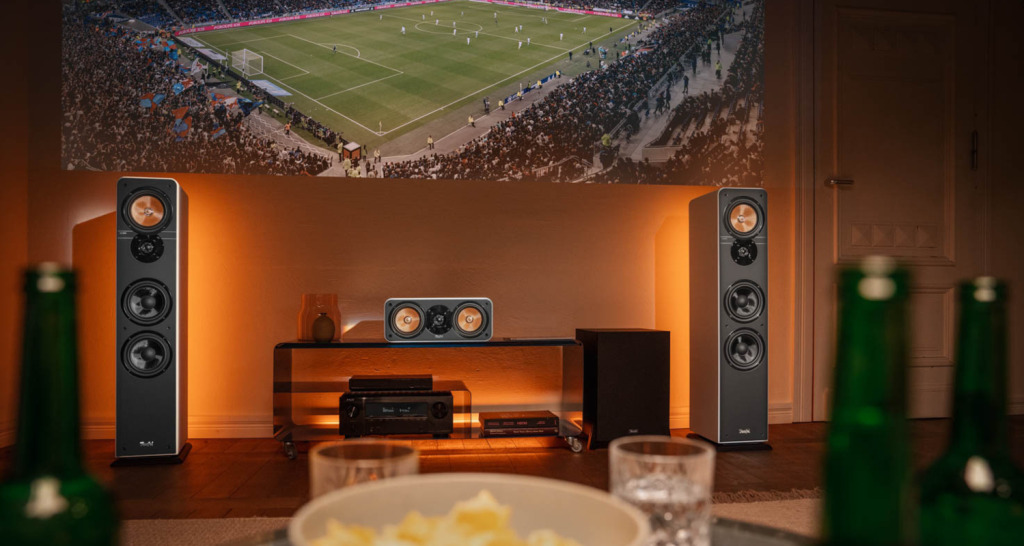
A World Cup evening lives from the big moments as well as the small ones: the first murmur before kick-off, the anthem echoing through the stadium, the brief gasp after a shot hits the post. With many TV speakers, these details are quickly lost. Flat housings offer little resonance space, small drivers deliver hardly any bass, and downward- or rear-facing speakers often make the sound feel less direct.
A soundbar brings the sound clearly to the front. Voices become easier to understand, fan chants feel wider, and cheers gain more punch. This is particularly noticeable in football, because the sound constantly shifts between commentary, stadium atmosphere and fast-paced action. A good device keeps these layers better separated without you having to constantly adjust the volume.
To enjoy the World Cup in Dolby Atmos, you also need the right technology chain. The soundbar must support Atmos, the TV should pass the sound on via HDMI eARC or HDMI ARC, and a multichannel format should be enabled in the audio settings. The exact wording varies depending on the TV model: the options are often called “Bitstream”, “Passthrough”, “Automatic” or “Dolby Audio”. More on this in our guide “Connecting a soundbar”.
Soundbars from Teufel for your World Cup nights
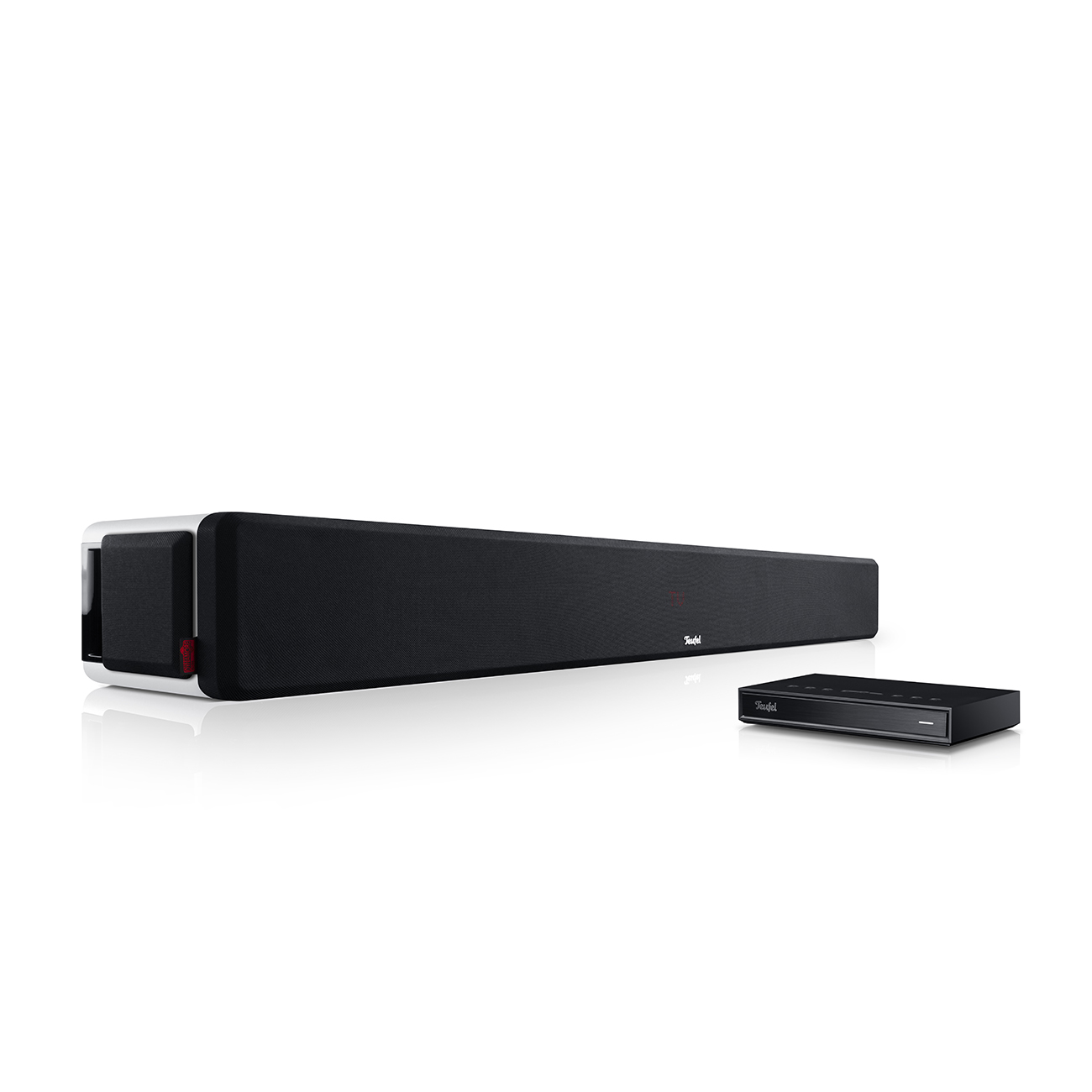
If you want not only to understand the commentary at the 2026 World Cup but also bring more stadium atmosphere into your living room, a Teufel soundbar is ideal. Depending on room size and setup, a compact 2.1 system may be enough – or you can go even further towards a home cinema feel with additional rear speakers.
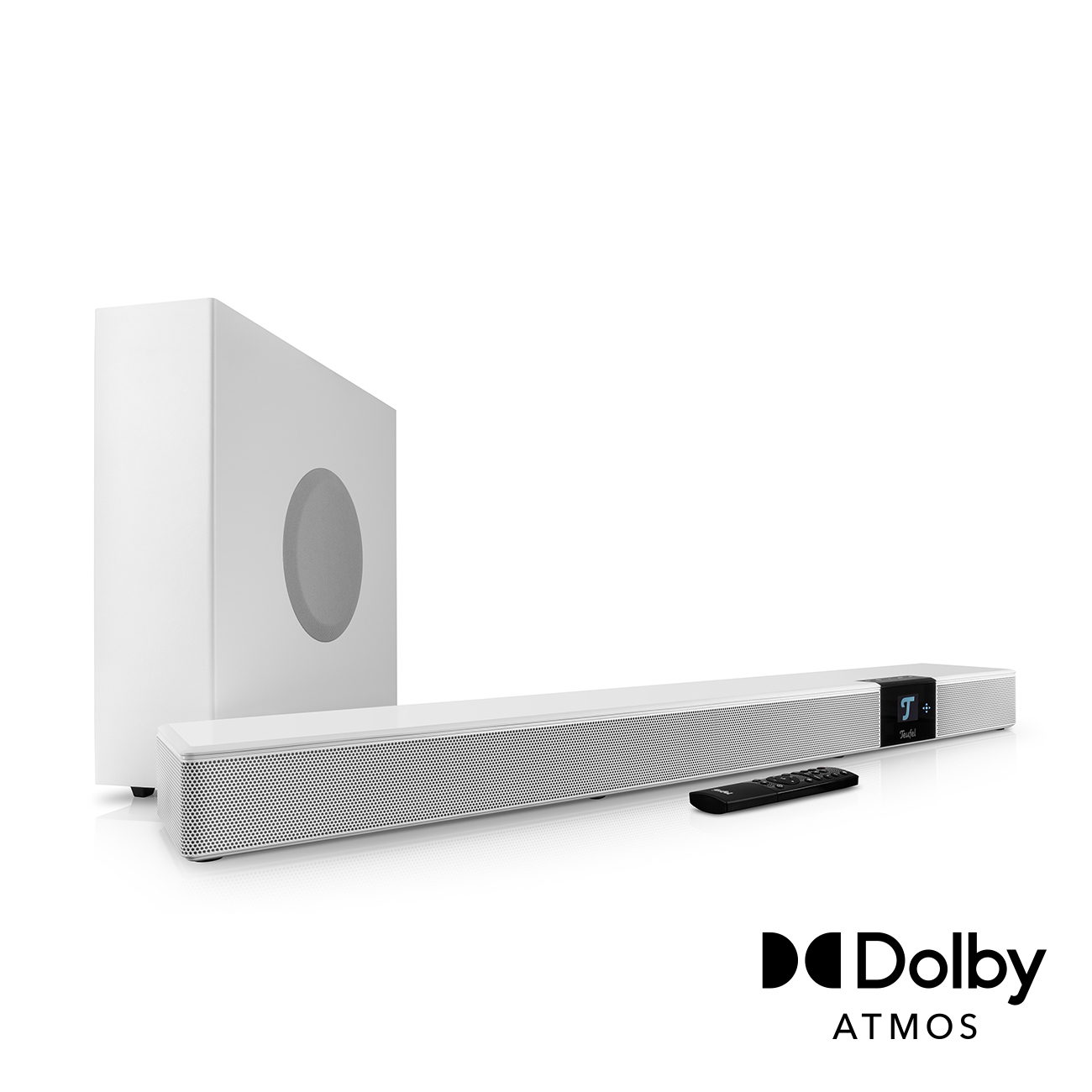
▶ CINEBAR 11 for Dolby Atmos “2.1 set”Opens in new tab: Slim soundbar with wireless subwoofer and Dolby Atmos support. A good fit if you want to keep your TV setup compact but expect significantly more body in presenters’ voices, bass and the overall stadium atmosphere than from the TV alone.
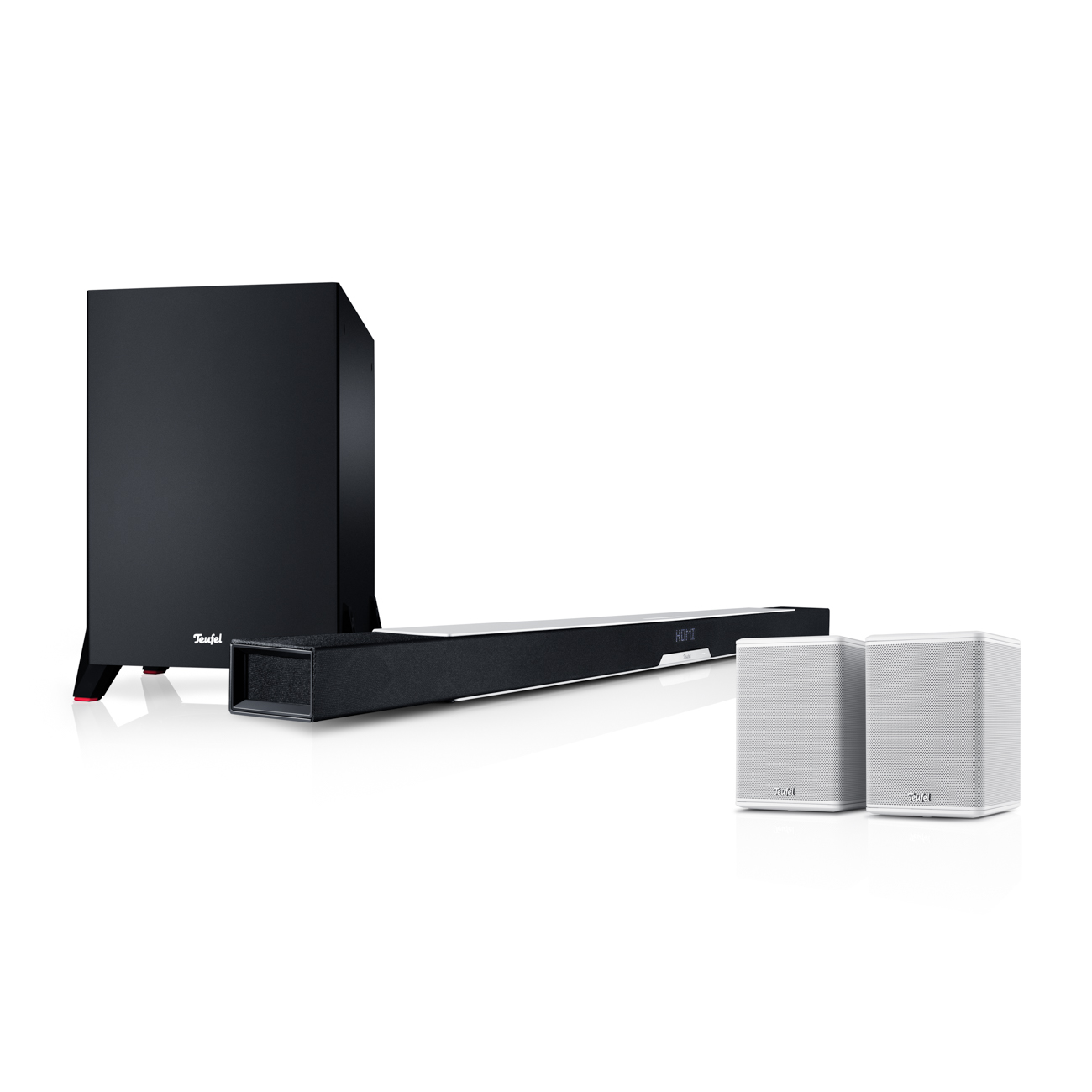
▶ Ultima 40 Surround AVR for Dolby Atmos “5.1.2 set”Opens in new tab: For anyone who wants not just a soundbar for the World Cup, but a real surround setup. The set combines compact bookshelf speakers, centre speaker, subwoofer and AV receiver with Dolby Atmos support.
▶ System 6 THX + Denon X3800H for Dolby Atmos “5.2.4 set”Opens in new tab: The larger solution for home cinema fans with space and high expectations. The set brings together multiple speakers, two subwoofers and an AV receiver – for powerful, room-filling sound on big football nights.
Right in the middle of it, not just there
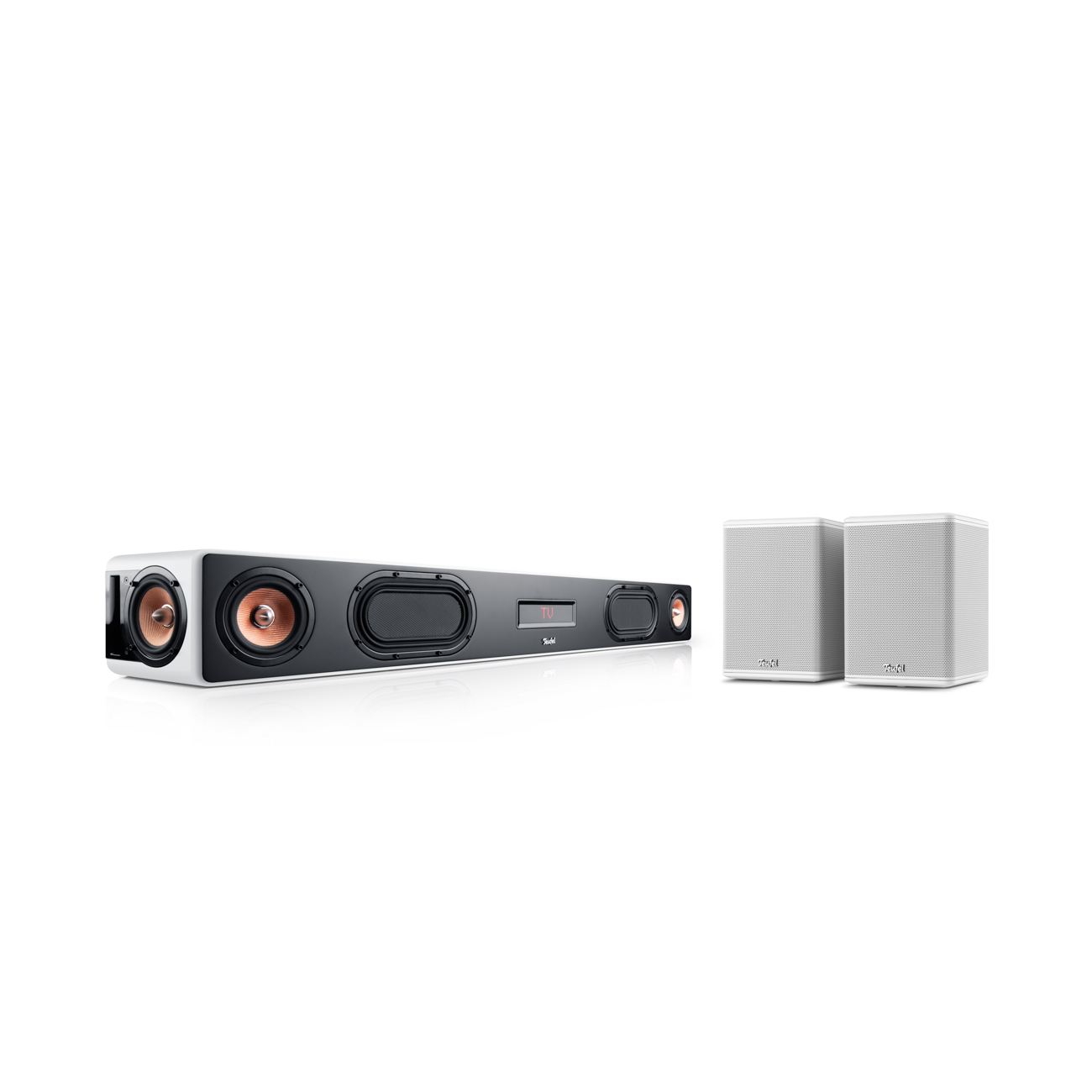
CINEBAR ULTIMA Surround "4.0-Set"
729,99 €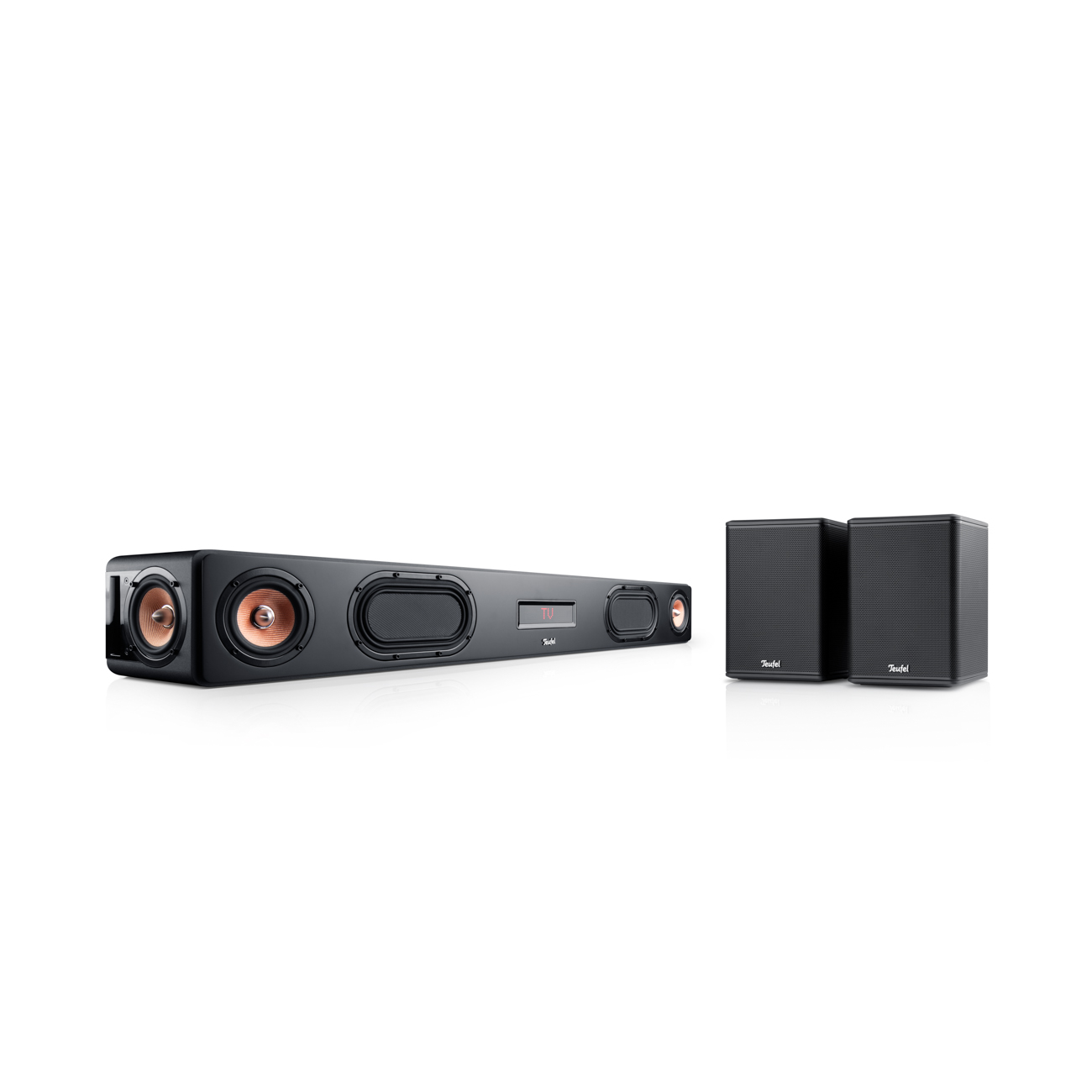
CINEBAR ULTIMA Surround "4.0-Set"
729,99 €Fun facts about the 2026 World Cup
- The 2026 World Cup is a tournament of long distances: between Vancouver in western Canada and Mexico City there are around 3,900 kilometres as the crow flies.
- The opening match kicks off on 11 June 2026 at Mexico City Stadium – the first venue to host an official opening game at three World Cups (after 1970 and 1986).
- The final takes place on 19 July 2026 in New York, more precisely at MetLife Stadium in East Rutherford. Normally, the NFL teams New York Giants and New York Jets play there.
- At the 2026 World Cup, there are planned to be two mandatory drinks breaks per half in every match to better protect players from the heat – each scheduled to last three minutes.
Frequently asked questions about the 2026 World Cup
The 2026 FIFA World Cup will take place from June 11 to July 19, 2026. The tournament will run for just under six weeks and, for the first time, will feature 104 matches.
The 2026 FIFA World Cup will kick off on June 11, 2026, with the opening match at Mexico City Stadium. The final will be held on July 19, 2026, at MetLife Stadium near New York.
Yes, but not just there. The 2026 FIFA World Cup will be co-hosted by the United States, Canada, and Mexico. Eleven of the 16 host cities are located in the United States, including Los Angeles, Dallas, Miami, Seattle, and New York/New Jersey.