
How do you develop a studio monitor that reproduces sound as faithfully as possible and, precisely because of this, sounds exceptionally accurate? In this interview, Senior Acoustic Engineer Max provides insights into the development of the STUDIO 5X and the challenges involved in designing an accurate studio monitor.
Between a reference tool and listening pleasure
Teufel Blog: What acoustic approach guided the development of the STUDIO 5X, and how does it deliberately differ from a Hi-Fi speaker?
Max: From an acoustic perspective, the following principle generally applies: a modern speaker with a neutral sound signature, controlled directivity, sufficient dynamic reserves and low nonlinear distortion will most likely deliver high playback quality both in a professional studio and in a living space. The main differences therefore arise primarily from the respective area of application.
 Opens in new tab
Hi-Fi speakers are generally developed for use in living spaces. In addition to reproducing music and films, aspects such as design, materials and perceived quality also play an important role. The acoustic design often needs to account for different listening distances, various placement options and the typical acoustic conditions of living spaces. Hi-Fi speakers are also more frequently tuned with a particular sound signature to create an especially impressive effect and stand out from competitors. In the high-end Hi-Fi segment in particular, exclusive design, material-intensive cabinet concepts and complex manufacturing processes are also highly significant. However, these features often have no influence, or only a very limited influence, on the actual acoustic playback quality.
Studio monitors, by contrast, are more strongly designed around their function as working tools. They serve as an analytical reference and should reproduce the source material as faithfully as possible so that reliable decisions can be made during the recording, mixing and mastering process. The focus is therefore on a neutral sound signature, controlled directivity, low distortion, high operational reliability and dependable integration into professional monitoring environments. For this reason, studio monitors are usually designed as active systems in which the amplifiers and signal processing are precisely matched to the drivers used and to the system as a whole.
 Opens in new tab
There are also professional connections that provide defined levels, high interference immunity and reliable integration into studio environments, for example through balanced analogue inputs. A robust electronic and mechanical design is equally important so that the technical characteristics specified in the data sheet continue to be met reliably over time. Various protection circuits are also frequently used to minimise the risk of damage and failure, even at high levels, during long listening sessions or in the event of improper use.
 Opens in new tab
What neutrality really means
Teufel Blog: The STUDIO 5X is designed as a studio monitor with neutrality and precision in mind. What does this mean in practical terms for its acoustic design?
Max: The primary objective is to achieve the most faithful sound reproduction possible. The speaker should follow the input signal as precisely as possible. At the same time, it must have controlled directivity so that both the direct sound and the reflections generated within the room exhibit the most consistent possible tonal behaviour. This allows the sound reaching the listening position to be perceived as natural.
Furthermore, distortion from the drivers and the integrated electronics should remain as low and controlled as possible, even at high levels, so that the speaker performs cleanly within its intended range of use. The cabinet and components must also be designed to minimise resonances and unwanted vibrations so that they do not impair playback quality. All of these aspects were central to the development of the STUDIO 5X and were implemented consistently.
For clarity in the mix: coaxial 3-way system
Teufel Blog: The acoustic configuration of the STUDIO 5X stands out thanks to its true 3-way system and coaxial mid-high-frequency driver. What role do the individual drivers play, and why is this configuration so important for localisation within the mix?
Max: The STUDIO 5X is one of the few studio monitors in its price class to feature a true 3-way design. The bass, midrange and treble are each reproduced by dedicated drivers. This means that the woofer does not also need to handle large parts of the midrange, which is a typical design compromise in many 2-way systems.
 Opens in new tab
This offers advantages primarily at higher levels: if a woofer has to make large excursions while simultaneously reproducing midrange content, increased intermodulation distortion can occur. In the STUDIO 5X, a separate midrange driver handles almost the entire midrange and vocal range. This keeps voices, instruments and subtle details in the mix better separated, while significantly reducing intermodulation distortion compared with most conventional 2-way systems in this price class.
 Opens in new tab
The mid-high-frequency unit is designed as a coaxial system, with the midrange driver and tweeter positioned on a common axis. As a result, most of the frequency spectrum is radiated from almost the same point in space. This allows the system to approximate an ideal point source. This is particularly beneficial when working on a mix because the spatial imaging is more stable and precise than that of conventional 2-way systems with offset drivers.
This makes decisions about panning individual instruments considerably easier. The sound detaches more effectively from the speakers, the image feels more spacious and individual elements within the mix can be positioned more precisely. Reverb spaces and effects can also be applied and assessed more reliably thanks to the more accurate representation of depth.
Precision instead of compromises
Teufel Blog: Which acoustic challenge proved particularly demanding when tuning the STUDIO 5X, for example in terms of directivity, bass or DSP integration?
Max: To ensure that the STUDIO 5X provides the most reliable possible reproduction even in less acoustically optimised listening rooms, such as semi-professional home studios, particular emphasis was placed on controlling the directivity of the entire speaker system. For this purpose, a specially developed waveguide was integrated into the coaxial mid-high-frequency unit. This technically demanding design solution required close collaboration with our in-house mechanical engineering team and remains unique in this price and size class.
 Opens in new tab
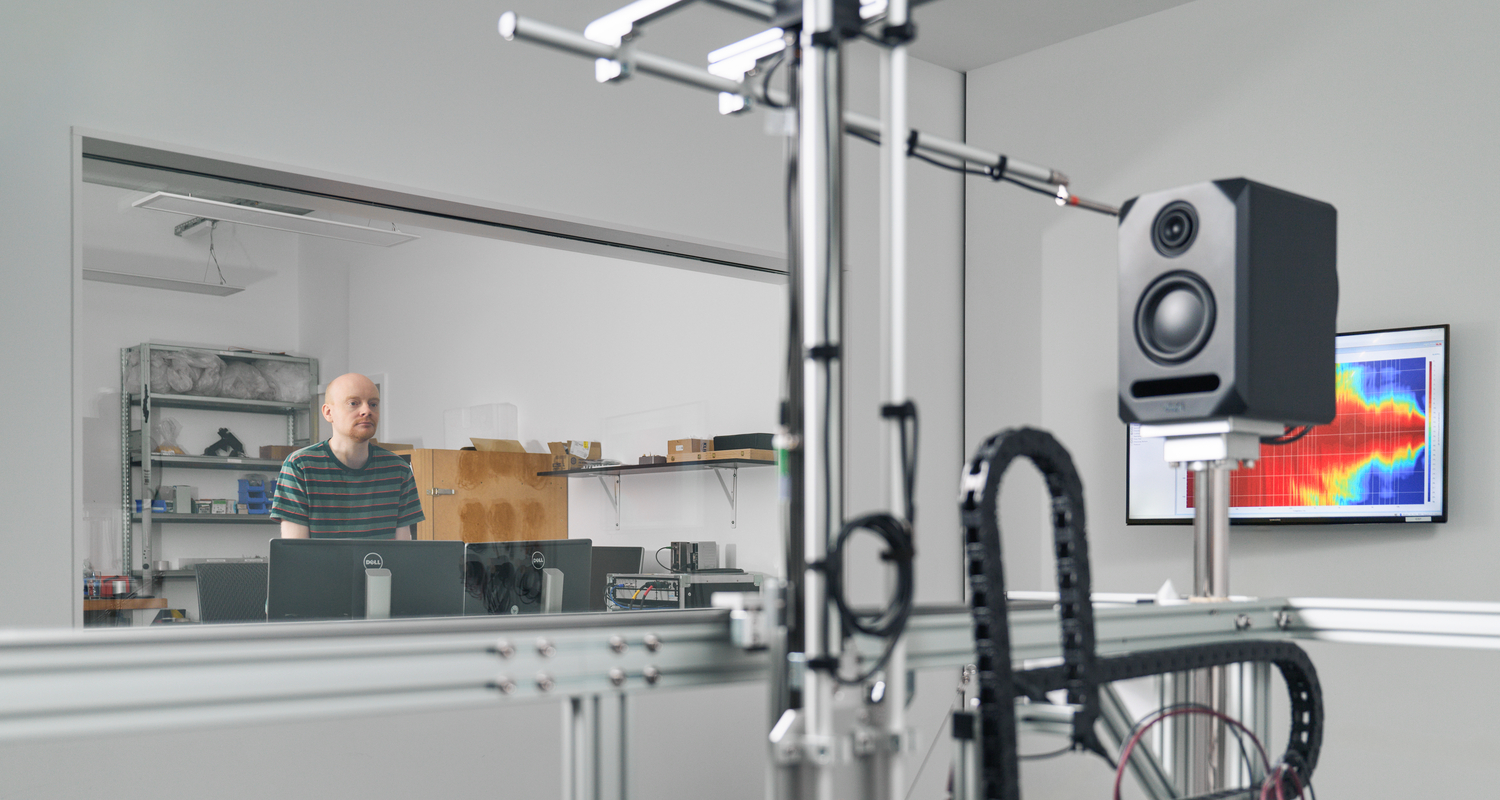
The Klippel Near-Field Scanner system made it possible to obtain precise acoustic measurement data from pre-production prototypes. This data provided targeted support for the development and tuning process in achieving the defined development objectives.
 Opens in new tab
As a result, the sound radiated directly by the speaker and the sound components reflected by the room are perceived as tonally similar. This contributes to natural sound reproduction while also enlarging the sweet spot. The listening position therefore becomes less critical, making it possible to work for longer and with greater concentration when producing, mixing and evaluating music.
The low- and mid-frequency drivers of the STUDIO 5X were also optimised using a Klippel Analyzer. The excursion and vibration parameters were tuned so that the drivers operate precisely in their respective cabinets in accordance with the development objectives and produce only low nonlinear distortion even at large excursions. This made it possible to extend the bass response to an impressive 37 Hz despite the compact cabinet size (based on a level drop of –10 dB), as the woofer offers a large yet highly linear excursion.
 Opens in new tab
An internally developed microcontroller also contributes to the excellent value for money of the STUDIO 5X. It handles not only the usual control tasks, such as reading buttons and controls and operating the product LEDs, but also the entire audio DSP processing. This made it possible to reduce the active electronics, with the exception of the amplifier ICs, to a single chip that provides complete control of the speaker system.
Studio DNA for the home
Teufel Blog: If you had to describe the STUDIO 5X as a tool for producers, which acoustic feature best demonstrates to you that it is a genuine studio monitor?
Max: One feature of the STUDIO 5X that is usually found only in considerably more expensive studio monitors is the use of FIR-based linear-phase filters in the audio DSP. This allows the speaker to achieve an almost ideal step response, in which all signal components are reproduced simultaneously and differences in group delay are compensated for. Particularly with percussion instruments such as snare drums or kick drums, this results in precise and faithful sound reproduction because the transients are not affected by timing shifts between individual frequency components but are preserved as a coherent event.
 Opens in new tab
At first, this difference is often perceived only as a subtle nuance in the sound. With increasing listening experience, however, the added precision usually becomes clearly perceptible and appreciated. Thanks to our cost-effective audio DSP developed in-house, it was possible to implement this technology in the price class of the STUDIO 5X. Combined with the controlled directivity, this creates a neutral, dry and precise sound image that distinguishes the STUDIO 5X as a genuine studio monitor for professional monitoring applications.
Teufel Blog: Thank you very much for these fascinating insights.
 Opens in new tab
Images / graphics: Teufel