
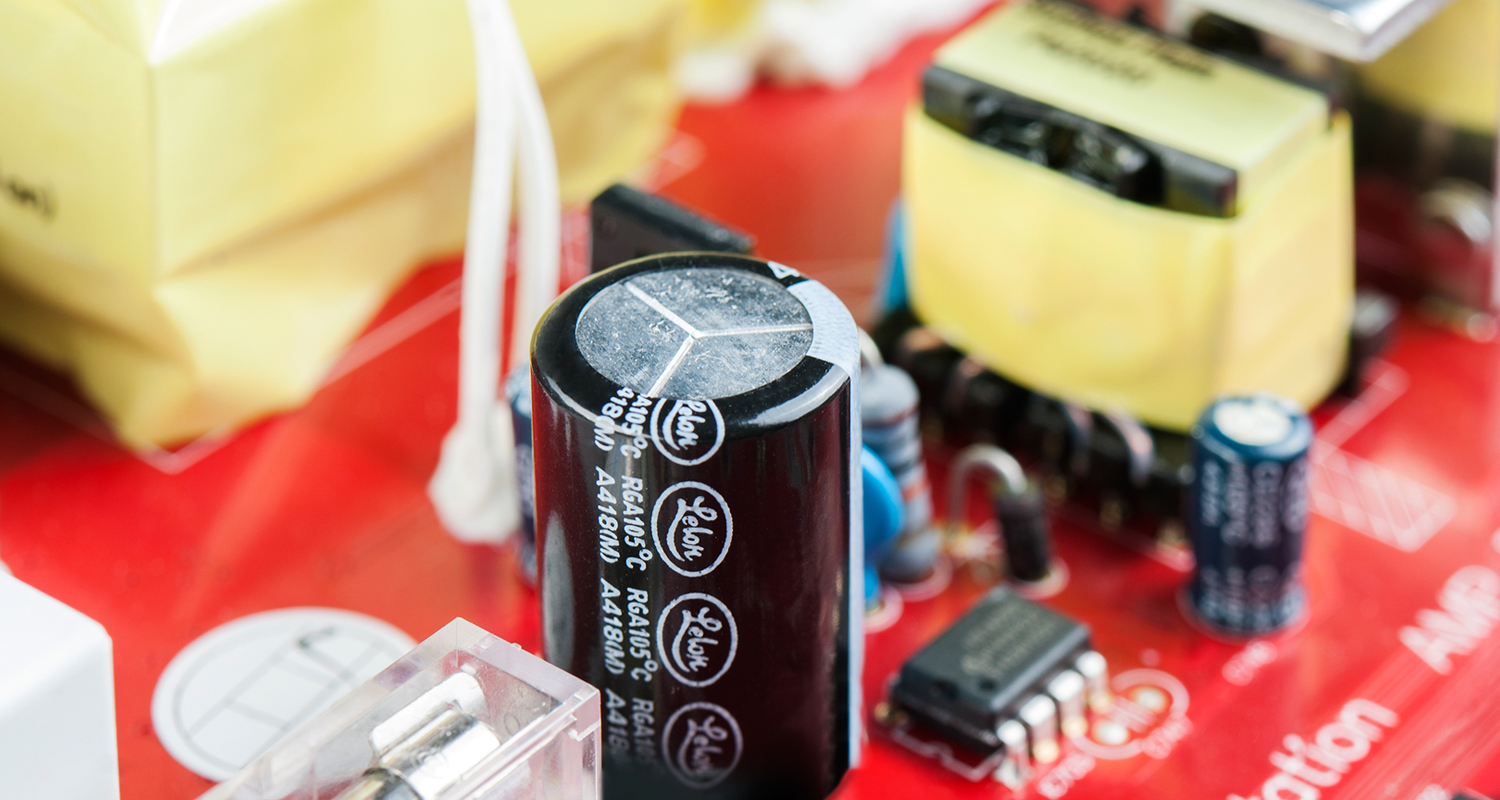

Capacitors play an important role in electrical engineering and therefore also in the world of hi‑fi. Why capacitors are so important in speakers and similar devices is explained here!
Small multi‑talents
A capacitor is an electronic component that, put simply, is able to store electrical charge. This also allows a capacitor to counteract rapid voltage changes, which is particularly useful in the hi‑fi sector. For example, a capacitor helps to deliver a signal that is as constant as possible to the speaker. In practice, capacitors are used especially when bass levels fluctuate strongly. If the bass level in a song rises quickly and sharply, there may not be enough voltage available. In such a case, the capacitor briefly steps in with its stored energy.
This is referred to as “smoothing” the DC voltage. For this purpose, power supply capacitors are installed in the amplifier, enabling a clean, “smooth” DC voltage. Without such power supply capacitors, the voltage would be undefined and could not be processed further. Graphically speaking, the voltage would then consist only of large sine waves that drop back to zero volts after each peak. To prevent the result from looking so fragmented, the capacitors must fill these gaps with their previously stored charge.
Coupling amplifier stages
Another application of capacitors is coupling two amplifier stages, for example the preamplifier and the power amplifier. When the signal passes from the preamp to the power amp, ideally only the actual information should be transferred. That means only the AC voltage should be transmitted, not the DC voltage. This task is handled by the coupling capacitor, which blocks the DC voltage but allows the AC voltage to pass. By the way, two conventional amplifiers can also be connected in this way. The coupling capacitor should also transmit the desired frequency range in a completely frequency‑linear manner.
These Teufel products might interest you
CONSONO 35 + Yamaha RX-V4A "5.1-Set"
749,99 €
ULTIMA 20 Surround + Yamaha RX-A2A for Dolby Atmos 5.1.2
1699,99 €
ULTIMA 20 CONCEPT Surround Power Edition "5.1-Set"
749,99 €On the crossover
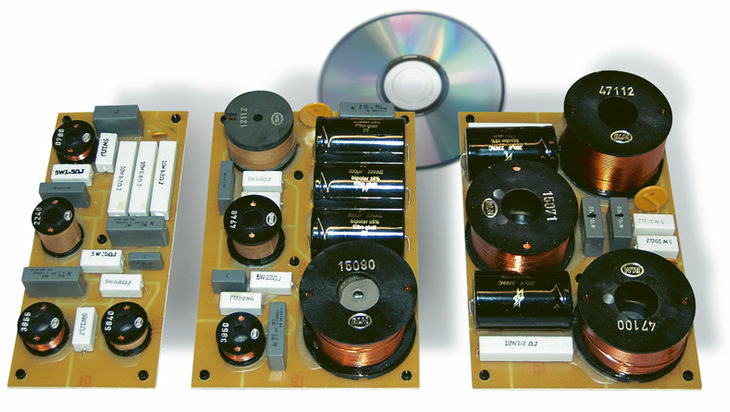
Here on the blog, we have already introduced the crossover. It also contains several capacitors of different sizes. Without them, the crossover would not work properly. The task of the capacitors is to allow only high frequencies to pass through. The coil, meanwhile, performs the opposite task and allows low frequencies to pass but not the high ones. The coil therefore acts as a low‑pass filter, while the capacitor works as a high‑pass filter. Depending on the speaker for which the crossover is built, larger or smaller capacitors and coils are installed.
How it works
The term “capacitor” comes from the Latin word “condensare”, meaning “to condense”. Today, there are many different designs of capacitors, but they all work according to a similar principle:
Calculating a capacitor
The larger the capacitor, the more charge it can store. How much charge it can actually store is usually stated directly on the capacitor. If this is not the case, you can also calculate the capacitor’s capacity yourself. To do so, you need this formula: Calculate a capacitorOpens in new tab. Alternatively, you can of course research the value based on the manufacturer and model designation.
Capacitor capacity is specified in farads (F), usually in microfarads (µF). If the capacity is, for example, 1 farad, the capacitor can store a charge of one coulomb (C) when charged to a voltage of one volt (V). The voltage on the capacitor is also specified in volts (V). However, the stated value always leaves some margin, for example 20 percent more than actually required. If a capacitor is operated at +50 volts, values such as 63 V and 5,000 µF are typically found. Manufacturers usually guarantee correct operation under these conditions up to a temperature between 70 and 80 degrees.
What can I do if a capacitor fails?
A capacitor can fail if it is exposed to excessive heat above 80 degrees (for example due to strong sunlight). White smoke rising from the amplifier housing is a sign of a defective capacitor. Anyone who owns older hi‑fi devices has probably had a capacitor replaced in a speaker or elsewhere at some point, or even replaced one themselves. With a bit of DIY experience, this is certainly possible to do on your own. However, inexperienced users should leave the task to a professional.
In addition to excessive heat exposure, a defect can have very different causes. Very often, however, the dielectric is affected. This is the insulating layer between the two electrodes. In many capacitors, the dielectric consists of a kind of gelled water mixture, which can dry out over the years. The capacitor then either loses its capacity or develops a short circuit. A loud bang and the smoke formation described above are the result. It is difficult to estimate when a capacitor will reach the end of its service life. For some, it happens after just five years, while others last 20 years or more. Some capacitors can even survive for half a century.
Reading tip: Music enjoyment on two channels: the stereo system (and its history).
Built to last: high‑quality stereo speakers from Teufel
Of course, we can’t promise that your new stereo speaker systemOpens in new tab from Teufel will last for half a century. Maybe it will. In any case, it will deliver excellent sound to your living room in all playback scenarios. Discover the ULTIMA(tive) sound experience!
▶ ULTIMA 40 KOMBO 3Opens in new tab: the complete solution for full sound enjoyment! With the new ULTIMA 40 floorstanding speakers and the KOMBO 62 Mk2 CD receiver, this set is designed for rooms up to 35 m². The receiver’s 2 x 130 watts provide plenty of power to reproduce your favorite music or TV sound vividly and dynamically. In addition to Bluetooth with AAC, DAB+ digital radioOpens in new tab is also on board.
▶ Theater 500 Surround “5.1 set”Opens in new tab: this all‑rounder for music enjoyment, home cinema with surround soundOpens in new tab and gaming features a precise 3‑way system. Thanks to the bass reflex system, the floorstanding speakersOpens in new tab deliver excellent performance in any position.
Top speaker sound? You can get that via Bluetooth too!
ROCKSTER 2 + Shure PGA58
1184,99 €
BOOMSTER GO
99,99 €
Fender x Teufel ROCKSTER GO 2
119,99 €Conclusion: capacitors are essential in speakers & more
- A capacitor can store electrical charge and use it to quickly compensate for voltage fluctuations.
- This allows rapidly and sharply rising bass levels to be regulated with an extra burst of energy, and the DC voltage to be “smoothed”.
- You can also use a capacitor to couple two amplifier stages or to allow only certain frequencies to pass through.
Audioblog
The podcast has been automatically generated by AI, but the content comes directly from an article written by our own editorial team. This ensures the quality remains high and allows you to hear our story in a new format.
- Title image: Elcap, Jens Both, “Kondensator‑Al‑Elko‑Wiki‑07‑02‑11”. Source: Wikimedia CommonsOpens in new tab. License: CC BY‑SA 3.0Opens in new tab.
- Image 1: Frank Klemm, “Photo crossover with CD”. Source: Wikimedia CommonsOpens in new tab. License: released into the public domain (Public Domain).




Leave a Reply